mail
admin@editorjprims.com
whatsapp
+919343055451
e-ISSN: 3049-1681
logo

Journal of Pharmaceutical Research and Integrated Medical Sciences

Journal of Pharmaceutical Research and Integrated Medical Sciences

Advancing knowledge through rigorous peer-reviewed research across multiple disciplines. Join the global community of scholars shaping the future of academic discovery.

📢 Latest Update: New special issue call for papers on "Emerging Technologies in Research" - Submit by March 31, 2025

📢 Latest Update: New special issue call for papers on "Emerging Technologies in Research" - Submit by March 31, 2025

Important Journal Details

Title:
Journal of Pharmaceutical Research and Integrated Medical Sciences
Journal Short Name:
jprims
e-ISSN (Online):
3049-1681
Year of Establishment:
2024
Frequency of the Publication:
Monthly
Publication Format:
Online
Related Subject:
Multi-DisciplinaryMedical Sciences
Language:
English
Editor-in-Chief:
Dr. Arpan Kumar Tripathi
Editorial Board:
Click Here →
Journal's Email ID:
admin@editorjprims.com

Download Forms & Formats

Download Hub

Publisher Details

Responsible Person Name:
Dr. Arpan Kumar Tripathi
Name of Publishing body:
AKT Publication
Publisher Website Url:
https://www.aktpublication.com
Address:
H-103, Nandi Parishar, Padmanabhpur, Durg, Chhattisgarh-491001

Journal Features

Rigorous Peer Review

All submissions undergo thorough evaluation by experts in the field to ensure quality and validity.

Global Reach

Published papers reach an international audience of researchers, academics, and industry professionals.

Rapid Publication

Efficient review process ensures timely publication of accepted papers without compromising quality.

Open Access

All published papers are freely accessible online, maximizing visibility and impact of your research.

Publication Process

1

Prepare Manuscript

Format your paper according to our guidelines

View Guidelines
style="fill: var(--journal-600);"
2

Submit Paper

Upload your manuscript through our system

Submit Now
3

Peer Review

Your paper undergoes expert evaluation

Learn More
4

Publication

Accepted papers are published worldwide

View Publications
View All Issues
Cover image for PROGRESS OF GALLIC ACID-DERIVED MICROCOMPOSITE GEL SYSTEMS FOR EFFECTIVE WOUND HEALING: A REVIEW

PROGRESS OF GALLIC ACID-DERIVED MICROCOMPOSITE GEL SYSTEMS FOR EFFECTIVE WOUND HEALING: A REVIEW

Anugrah Samanvay Tandi, Garima Sahu, Jaya Shree, Neha mandle

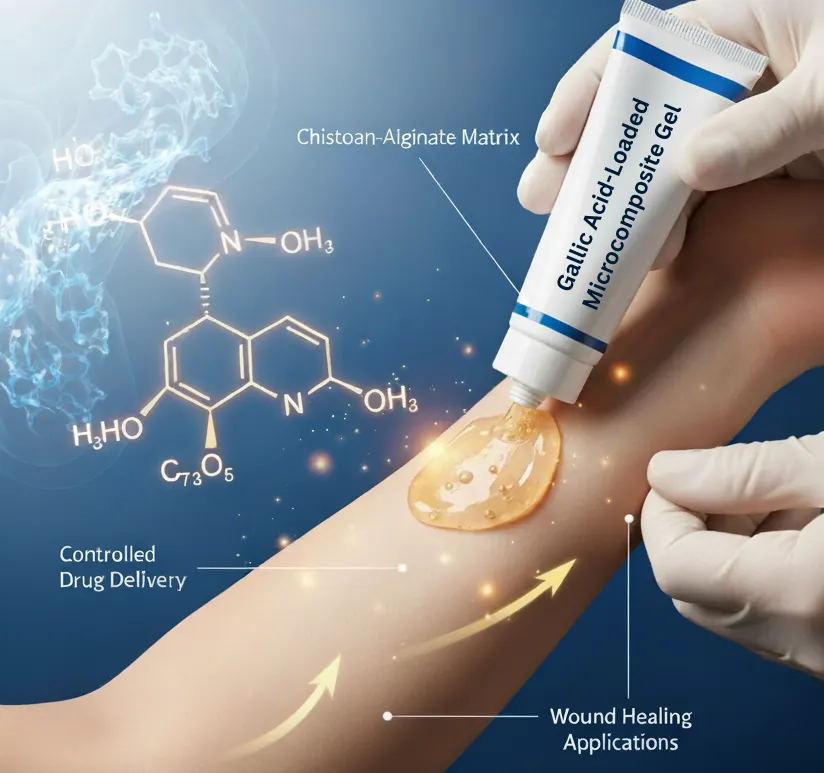
Management of chronic wounds continues to be a formidable clinical problem, demanding novel therapeutic strategies that target various stages of the healing cascade. Natural polyphenolic compounds such as gallic acid have been attracting interest as potential wound healing agents because of their multiple therapeutic activities. This review discusses in detail the preparation, characterization, application of gallic acid-loaded microcomposite gels, and their in vitro and in vivo studies, and focuses especially on chitosan-alginate matrix formulations. Incorporation of GA in biocompatible polymer matrices is a strategy to overcome GA's poor solubility in water and low bioavailability, in general. This review comprehensively summarizes the available understanding on formulation approaches, physicochemical characterization methods, release kinetics, and therapeutic potentials of gallic acid-based microcomposite systems. The study results indicate that ionotropic gelation approaches incorporating optimized polymer blends are able to develop stable colloidal forms with favourable particle size distribution, improved EE and controlled release patterns. The pseudoplastic rheology and the physiologically compatible pH ranges of these formulations result in enhanced patient compliance and therapy. Future directions of research therefore should involve comprehensive in vivo studies and real clinical validation of safety and efficacy that would be most welcomed for such new systems of drug delivery.
Cover image for Development and Quality Assessment of Sustained Release Tablets Containing Metformin Using Hydrophilic Polymers

Development and Quality Assessment of Sustained Release Tablets Containing Metformin Using Hydrophilic Polymers

Mausami, Vikas Kumar Sahu, Pushpa Nirmalkar, Aanchal Yadu, Jitendra Kumar

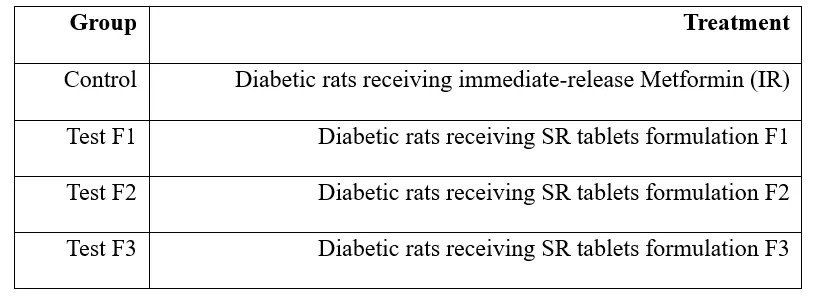
The aim of the current research is to prepare and test sustained-release (SR) tablets of Metformin hydrochloride using hydrophilic polymers such as Hydroxypropyl Methylcellulose (HPMC), Xanthan gum and Eudragit RSPO so as to attain sustained glycemic control in diabetic animal models. The wet granulation method is used to prepare tablets and the physicochemical properties such as weight variation, hardness, friability, thickness and uniformity of drug content are determined and all are found to be within acceptable limits. In vitro drug release showed a release of Metformin is controlled over 12 hours with release kinetics consistent with the Korsmeyer-Peppas model, reflecting diffusion and erosion. Sustained drug absorption is observed in streptozotocin-induced diabetic Wistar rats in which in vivo pharmacokinetic analysis of the SR formulations demonstrated a long Tmax and half-life (t1/2) and higher area under the plasma concentration-time curve (AUC) than immediate-release Metformin. One-way ANOVA and Tukey post-hoc statistical analysis showed that there are significant differences between formulations (p

Cover image for Evaluation of Process Analytical Technology (PAT) in Monitoring Granulation Parameters for Improved Tablet Uniformity.

Evaluation of Process Analytical Technology (PAT) in Monitoring Granulation Parameters for Improved Tablet Uniformity.

Vikas Kumar Sahu, Mausami, Pushpa Nirmalkar, Aanchal Yadu, Jitendra Kumar

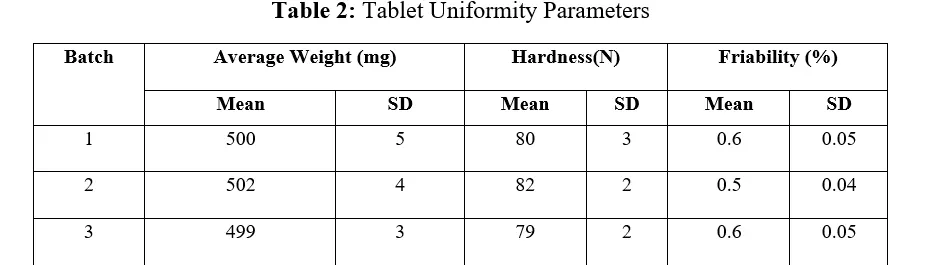
Therapeutic efficacy and safety of pharmaceutical tablets largely depend on their uniformity and quality, especially during preclinical studies. This study will assess the use of Process Analytical Technology (PAT) to monitor granulation parameters in real time to enhance the consistency of tablets. During wet granulation, properties of the granules including particle size, moisture content, and bulk density are continuously measured using near-infrared spectroscopy (NIRS) and in-line particle size analyzers using animal-model-compatible formulations. GRS PAT granules are converted into tablets and examined concerning mass homogeneity, firmness, and friability and compared with non-PAT batches. Findings indicated that PAT-controlled production has led to a large decrease in the batch-to-batch variability resulting in tablets of uniform physical characteristics and mechanical strength. The statistical analysis revealed that batches approached by PAT is superior to conventional processes. The results indicate that the use of PAT in preclinical preparations improves process controls, variability, and stable tablet quality, which is a key to its usability as a standard method in early pharmaceutical development.

Publication Process

Learn about our 4-step publication process

Submission Guidelines

Review requirements before submitting

Submit Article

Ready to submit your research?

76
Published Articles
1,523
Active Researchers
45
Countries
4.2
Impact Factor