
mail
admin@editorjprims.com
whatsapp
+919343055451
e-ISSN: 3049-1681
logo

Journal of Pharmaceutical Research and Integrated Medical Sciences

📢 Latest Update: New special issue call for papers on "Emerging Technologies in Research" - Submit by March 31, 2025

📢 Latest Update: New special issue call for papers on "Emerging Technologies in Research" - Submit by March 31, 2025

April 2025

Volume 2, Issue 4 - $2025

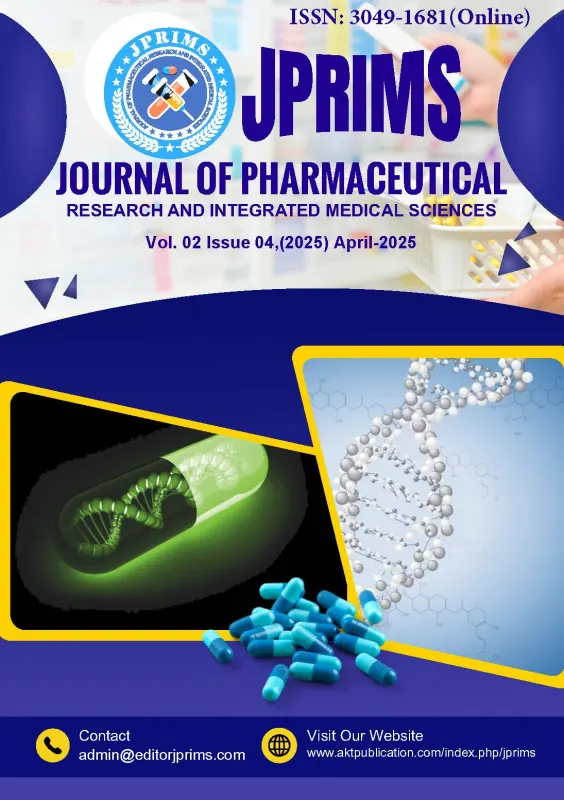
Volume 2 Issue 4 Cover

Issue Details:

Volume 2 Issue 4
Published:Invalid Date

Editorial: April 2025

Welcome to the 2025 issue of Journal of Pharmaceutical Research and Integrated Medical Sciences. This issue showcases the remarkable breadth and depth of contemporary research across multiple disciplines. From cutting-edge applications of machine learning in climate science to the revolutionary potential of quantum computing in drug discovery, our featured articles demonstrate the power of interdisciplinary collaboration in addressing global challenges.

We are particularly excited to present research that bridges traditional academic boundaries, reflecting our journal's commitment to fostering innovation through cross-disciplinary dialogue. The integration of artificial intelligence with environmental science, the application of blockchain technology to supply chain management, and the convergence of urban planning with smart city technologies exemplify the transformative potential of collaborative research.

As we continue to navigate an era of rapid technological advancement and global challenges, the research presented in this issue offers both insights and solutions that will shape our future. We thank our authors, reviewers, and editorial board members for their continued dedication to advancing knowledge and promoting scientific excellence.

Dr. Arpan Kumar Tripathi
Editor-in-Chief
Journal of Pharmaceutical Research and Integrated Medical Sciences

Articles in This Issue

Showing 5 of 5 articles
Research PaperID: JPRIMS420057

Nicotine Dependence Diagnosis Methods

Vamini Madhukar, Preeti K Suresh, Deepak Biswas

Tobacco use is the leading preventable cause of premature death and diseases in the world. Nicotine is the causal agent for the addiction of people to tobacco. To reduce the mortality and morbidity caused by tobacco use the only way out is to make people free from this monstrous addiction. The goal of this work is compilation of different diagnostic methods available to help people in the diagnosis of their level of addiction to nicotine. Various diagnostic methods included are Fagerstrom Test for Nicotine Dependence (FTND) and Heaviness of Smoking (HSI), Features of Diagnostic and Statistical Manual-IV, Features of the International Statistical Classification and Related Health, The Tobacco Dependence Screener (TDS), The Cigarette Dependence Scale (CDS), The Nicotine Dependence Syndrome Scale (NDSS), Wisconsin Inventory of Smoking Dependence Motives (WISDM), The Fagerstrom Test for Nicotine Dependence-Smokeless Tobacco (FTND-ST). These questionnaires are simple, easy to answer and assess. A number of smokers try to quit and fail in their attempt in lack of proper strategic planning. With the use of these questionnaires and by assessing their addiction level one can successfully plan for their quit attempt and benefit with it in a positive way.

4,410 views
1,211 downloads

Contributors:

 Vamini Madhukar
,
 Preeti K Suresh
,
 Deepak Biswas
Research PaperID: JPRIMS420058

Formulation and Evaluation of Multilayer Matrix Tablet of Captopril forOral Controlled Delivery

Deepak Biswas, Vamini Madhukar, Arpan Trpathi

The current study aimed to develop an oral controlled drug delivery system for captopril, a highly water-soluble drug. Captopril is a highly water-soluble drug if not formulated properly may release the drug immediately and cause toxicity. Half-life of captopril is around 2-3 hours with 60-75% of bioavailability and prescribed thrice a day, due to this reason an attempt was made to prepare multilayer matrix tablet of captopril for its controlled and durable release. Multilayer matrix tablets of captopril were prepared by compressing 100mg of guar gum granules containing either 60%(T1), 70%(T2) and 80%(T3) of guar gum on both sides of matrix powder of captopril containing either 1:2, 1:1 and 2:1 ratio of HPMC and ethyl cellulose, above which an immediate release layer is compressed having the loading dose of captopril forming the fourth layer of the multilayered matrix tablet. The respective formulations were coded as T1M1, T1M2, T1M3, T2M1, T2M2, T2M3, T3M1, T3M2 and T3M3. Result: Values for bulk densities, tapped density, compressibility, Hausner ratio and angle of repose for all the prepared powder and granules were found in a range of 0.33 to 0.446, 0.37 to 0.50, 8.002 to 16.27, 1.08 to 1.16 & 25.96 to 27.7 respectively. Whereas, values for thickness, friability, hardness, Weight variation and content uniformity is found to be 7.14±0.27 to 7.29±0.22, 0.15 to 0.33, 5.7±0.28 to 5.9±0.27, 645.4±2.9 to 649.5±4.7 & 97.79±0.52 to 101.12±0.50 respectively. Swelling study indicates the % swelling of the polymers and the study reviles that maximum swelling were obtained with the formulation T3M3. Dissolution profile defines that the concentration of polymer plays an important role in the release of drug. The values of drug release for the formulation T1M1 to T3M3 after 12 hours were found to be in between 68.91 to 96.47 % respectively.

diagnostic methods.History:cigarettesaddictionTobacco
4,427 views
1,252 downloads

Contributors:

 Deepak Biswas
,
 Vamini Madhukar
,
 Arpan Trpathi
Research PaperID: JPRIMS420059

Applications of Quantum Chemistry in Molecular Spectroscopy and Reactivity

Deleshwar Kumar

Quantum chemistry is critical in the explanation of molecular structures, spectroscopy, and chemical reactivity through the application of quantum mechanical principles to chemical systems. This review talks about how quantum chemistry is used in different types of molecular spectroscopy, like UV-Vis, infrared (IR), Raman, and nuclear magnetic resonance (NMR) spectroscopy, where quantum calculations help predict changes in electrons, vibrations, and spin interactions. Also, the research considers quantum chemistry's role in chemical reactivity by charting possible energy surfaces (PES), locating transition states, and minimizing reaction paths with computational techniques such as Density Functional Theory (DFT), ab initio methodologies, and Quantum Molecular Dynamics (QMD). The marriage of quantum chemistry and experimental methodologies has greatly facilitated drug discovery research, catalysis research, and materials science research to the extent that innovations in energy storage and sustainable chemistry have emerged. Despite the achievements, challenges in the form of computational expense, accuracy limitations of electron correlation models, and improvement of hybrid functionals persist. Improving computational efficiency, integrating quantum chemistry with machine learning, and further development of its applications in quantum computing for more accurate predictive modelling are some directions that future research must pursue. This review emphasizes the revolutionary effect of quantum chemistry on contemporary scientific achievements and its future scope in spectroscopic studies and reactivity research.

Ethyl celluloseGuar gumHPMCMultilayer Matrix TabletCaptopril
4,385 views
1,303 downloads

Contributors:

 Deleshwar Kumar
Research PaperID: JPRIMS420060

Green Synthesis And Characterization OfMeteal Nanopartical For CatalyticApplication

Nisar Anjum, Dorendra Deshmukh, Bholenath Sahu, Neeraj Deshmukh

The green synthesis of metal nanoparticles is drawing considerable attention for its environmentally safe method where the reducing agent in the synthesis is plant extract for the synthesis of nanoparticles with engineered properties. Here, an effort has been made to conduct a green synthesis and characterization of silver, gold, and copper nanoparticles and assess their catalytic properties. Plant extract-based nanoparticles were synthesized and evaluated by UV-Vis spectroscopy, TEM, XRD, and FTIR, showing distinctive sizes, morphology, and crystal structures. Catalytic activity was assessed using 4-nitrophenol reduction, which showed the silver nanoparticles had maximum catalytic performance, followed by gold and copper nanoparticles. Statistical analysis revealed remarkable differences in the catalytic performances of the nanoparticles. This study points to the promise of green-synthesized nanoparticles for diverse catalytic uses, providing eco-friendly alternatives for industrial processes and environmental remediation.

Quantum Computing.History:Computational ChemistryChemical ReactivityDensity Functional Theory (DFT)Molecular SpectroscopyQuantum Chemistry
4,458 views
1,328 downloads

Contributors:

 Nisar Anjum
,
 Dorendra Deshmukh
,
 Bholenath Sahu
,
 Neeraj Deshmukh
Research PaperID: JPRIMS420062

Synthesis And Characterization of NovelOrganometallic Complexes for CatalyticApplications

Vinay Sagar Verma, Mohit Sahu

The discovery of effective organometallic catalysts is instrumental in driving catalytic processes in numerous industrial processes. The present research examines the synthesis, characterization, and catalytic activity of new organometallic complexes, including palladium (II) acetate (Pd(OAc)₂), platinum (II) chloride (PtCl₂), and rhodium (III) chloride (RhCl₃), and their ligand-based analogues. The complexes were prepared and characterized through NMR, IR, and XRD spectroscopy to establish their purity and structure. Catalytic experiments for hydrogenation and cross-coupling reactions were carried out, and the data indicated that Pd(OAc)₂ (ligand present) showed the highest catalytic activity, with 95% conversion and 93% yield for hydrogenation and 88% conversion and 85% yield for cross-coupling. Statistical evaluation by ANOVA supported the importance of differences in catalytic performance, where the Pd(OAc)₂ complexes were better than the rest of the tested catalysts. This research reveals the improved catalytic activity of Pd(OAc)₂ (with ligand), giving important insights into future industrial catalysis applications. The results imply that optimization and further investigation into ligand changes could result in more efficient and selective catalysts for a vast array of reactions.

sunshine
4,808 views
1,392 downloads

Contributors:

 Vinay Sagar Verma
,
 Mohit Sahu