
mail
admin@editorjprims.com
whatsapp
+919343055451
e-ISSN: 3049-1681
logo

Journal of Pharmaceutical Research and Integrated Medical Sciences

Published

Artificial Intelligence and Machine Learning Applications in Orthopedic Physiotherapy

Published in JPRIMS, Vol-2, Issue-9, Sep.-2025 (Vol. , Issue , )
Artificial Intelligence and Machine Learning Applications in Orthopedic Physiotherapy - Issue cover

Abstract

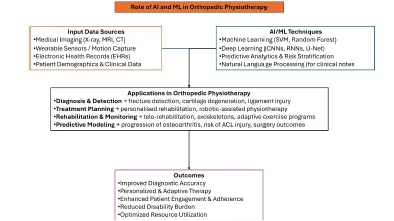
Background: Musculoskeletal disorders (MSDs), such as osteoarthritis, fractures, ligament injuries, and chronic back pain, affect over 1.3 billion people worldwide, posing significant clinical and economic burdens. Conventional orthopedic physiotherapy is essential for restoring mobility and reducing disability but is limited by subjectivity, variability in treatment outcomes, and challenges in personalization. Artificial intelligence (AI) and machine learning (ML)have emerged as transformative tools to overcome these gaps. Methodology: This mini-review synthesizes recent advances in AI/ML applications across diagnostic imaging, gait and posture analysis, wearable sensor technologies, predictive analytics, rehabilitation robotics, and tele-physiotherapy. Clinical applications, case studies, and technological innovations are evaluated to highlight their impact on patient assessment, treatment planning, and rehabilitation. Challenges such as data privacy, limited datasets, integration into clinical workflows, and algorithmic bias are also discussed. Results: AI enhances diagnostic precision through automated medical imaging analysis and computer vision–based gait assessment. Wearable sensors combined with ML enable continuous monitoring and adaptive therapy adjustments, while predictive models improve early detection of injury risks and disease progression. AI-assisted rehabilitation tools—including robotic systems, VR/AR platforms, and gamified therapy—enhance patient engagement, adherence, and recovery outcomes. Clinical applications demonstrate improvements in post-operative rehabilitation, chronic back pain management, arthritis grading, sports injury recovery, and remote physiotherapy delivery. Despite barriers, federated learning, IoT integration, multimodal AI, and fully autonomous physiotherapy assistants are emerging as future solutions. Conclusion: AI and ML are revolutionizing orthopedic physiotherapy by enabling precision diagnosis, personalized treatment, and adaptive rehabilitation strategies. While challenges in privacy, clinical adoption, and algorithmic robustness remain, ongoing innovations promise to establish AI as a cornerstone of musculoskeletal care. These technologies are poised to enhance patient-centered rehabilitation, improve global accessibility, and shape the future of physiotherapy practice.

Authors (2)

Nawaf Rawaf Alfahad

Prince Sultan Military Medical...

View all publications →

Hadeel Fahad Alothaim

College of Applied Medical Sci...

View all publications →

Download Article

PDF

Best for printing and citation

File size: 0.0 MB
Format: PDF

Download Article

PDF

Best for printing and citation

File size: 0.0 MB
Format: PDF

Article Information

Article ID:
JPRIMS1010158
Paper ID:
JPRIMS-01-000158

Article Impact

Views:3,828
Downloads:2,328

How to Cite

Nawaf Rawaf Alfahad & Hadeel Fahad Alothaim (). Artificial Intelligence and Machine Learning Applications in Orthopedic Physiotherapy. Journal of Pharmaceutical Research and Integrated Medical Sciences, (), xx-xx. https://jprims.scholarjms.com/articles/68

Article Actions